
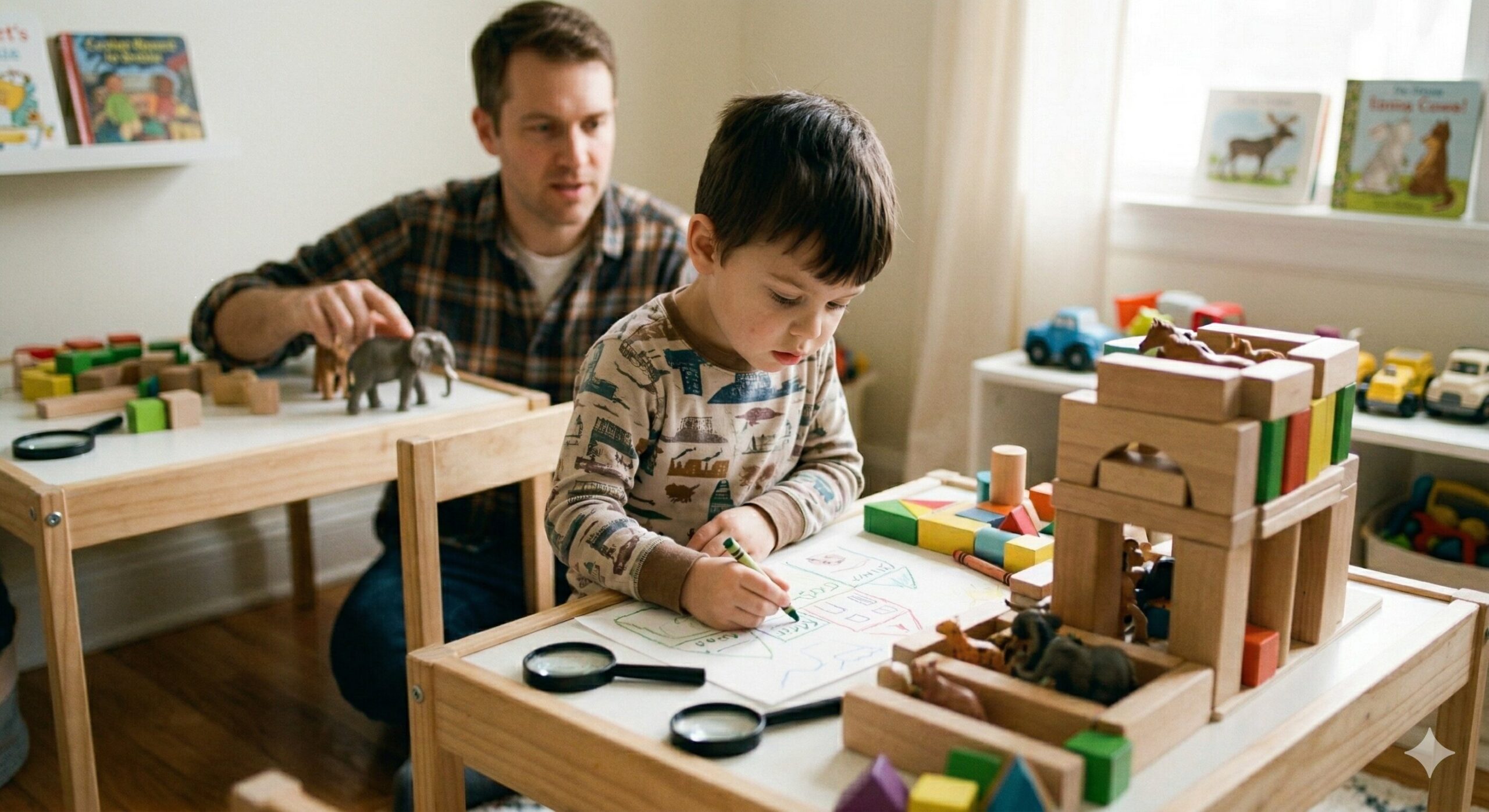
A child’s learning doesn’t start in the classroom; it begins long before that, in the ordinary, everyday experiences that slowly shape how they think and understand the world.
Have you ever paused and wondered what’s really going on inside your child’s mind when they stare at your face, figure out how a toy works, or ask “why” for the tenth time in a row?
That’s cognitive development in action, even if we don’t always notice it. It’s the way children gradually learn to think, remember, notice patterns, and make sense of their surroundings.
The important thing to remember is that this kind of growth doesn’t only happen in classrooms, during formal teaching, or through structured lessons. It unfolds naturally throughout the day: during play, in daily routines, through stories, conversations, and even in those small trial-and-error moments that might seem ordinary to us. And that’s exactly why real-life examples matter so much. They remind parents and teachers that meaningful learning is already happening, right in front of them, in the simplest, everyday experiences.
Importance of Cognitive Development in Early Childhood:
Cognitive development matters because it supports how children learn in every setting. It helps them pay attention, remember what happened before, understand cause and effect, solve simple problems, and build the foundation for later school learning. These early thinking skills also affect confidence, curiosity, and independence.
It is also closely connected to the broader picture of development. Families often hear about the 5 areas of development in early childhood: physical development, cognitive development, language and communication, social-emotional development, and adaptive (self-help) skills. In real life, these areas constantly overlap. A child using memory during a game, language during a story, and self-regulation during a task is building several areas at once.
What Is Cognitive Development in Early Childhood?
Cognitive development in early childhood is simply how children learn to think, remember, reason, focus, and make sense of the world around them.
It begins with very early abilities such as watching, recognising, reaching, and exploring. Over time, these grow into complex skills, such as problem-solving, prediction, sequencing, and understanding relationships between things.
This growth starts earlier than many people realize. Even in infancy, babies are already building the foundations of thinking through attention, exploration, and repeated interactions with people and objects. As children grow, those simple actions turn into more purposeful thinking. That is why cognitive development in infants 0-12 months matters just as much as the preschool years.
Examples of Cognitive Development in Early Childhood:
The easiest way to understand cognitive development is to see how it shows up in everyday moments.
In Infancy:
A very young baby may watch a caregiver move across the room or look at a toy for several seconds. By around 6 months, many babies actively reach for toys they want and explore objects by touching and mouthing them. These are early cognitive examples because the baby is paying attention, noticing objects, and learning through exploration.
You’ll also start to see the beginnings of cause and effect. A baby begins to learn that certain actions lead to certain results. Pressing, reaching, shaking, or repeating the same motion again and again is not random. It is part of how the child learns what happens when they act on the world around them.
Around Age 2:
By age 2, children start using what they know more purposefully. They start using switches, turn knobs, or press buttons on toys for a purpose. They may also play with more than one toy at a time, such as placing toy food on a plate or using one object together with another. These are strong examples of growing understanding, coordination between ideas, and early problem-solving.
This is also the stage where adults often notice how much memory is developing. A child may remember where an object belongs, anticipate what comes next in a routine, or repeat an action that worked before. These are small but important signs of cognitive growth.
Around Age 3:
By age 3, children often begin showing more visible thinking skills. A child may draw a circle after watching an adult do it, remember simple warnings, or apply what they learned in one situation to another. These examples show growing imitation, memory, and reasoning.
Children at this age also become more purposeful in play. They not only explore objects. They begin using them with more intention, remembering routines more clearly, and showing a stronger understanding of how actions lead to results.
Around Age 4:
At age 4, cognitive development becomes easier to notice in conversation and classroom-style activities. Many children can name a few colors, tell what comes next in a familiar story, and draw a person with several body parts. These are more than academic skills; they reflect memory, sequencing, prediction, and symbolic thinking.
You might also see it in problem-solving during play. A child may try different ways to build something, explain their thinking, or compare objects more thoughtfully. These are all examples of stronger thinking, not just better behaviour.
Around Age 5:
By age 5, many children can count to 10, recognize some numbers and letters, use words about time like “yesterday” and “tomorrow,” and pay attention for longer during non-screen activities. These are strong examples of cognitive development because they show memory, sequencing, focus, and growing readiness for formal learning.
This is why people often search for cognitive development milestones 3-5 years. These years bring very noticeable changes in how children think, organise information, and stay engaged with an activity. What looked like a simple exploration earlier starts becoming a more structured understanding.
Everyday Examples Parents and Teachers Often Miss:
Some of the best examples of cognitive development are easy to overlook because they seem ordinary.
- A child remembers where their shoes are kept.
- A toddler notices that one toy is missing.
- A preschooler predicts the next line in a story.
- A child sorts blocks by colour without being asked.
- A young learner realises that two objects are the same shape but different sizes.
- A child asks “why” again and again because they are trying to understand how things connect.
These are all examples of real cognitive growth. They show that the child is not just reacting to the world but beginning to organise it mentally.
Cognitive Development Milestones: Why Real-Life Examples Matter More Than Charts:
Parents and teachers often look for a cognitive development milestones chart because it feels reassuring to see growth laid out clearly. Charts are helpful, but examples are often even more useful. A chart might tell you what a child should be doing. Examples help you actually recognize it when it happens.
That is especially true in early childhood, where development can be uneven. One child may be strong in memory but slower in attention. Another may show curiosity and problem-solving early but take longer with language. Real examples help adults notice growth without treating development like a test.
Cognitive Development in Early Childhood Ages 2-6:
When people talk about cognitive development in early childhood ages 2-6, they are usually describing a period of very rapid change. Children move from simple exploration into more organised thinking. They begin to:
- Remember routines more clearly
- Solve problems with intention
- Ask more complex questions
- Understand time, sequence, and relationships
This is one reason the early years matter so much. The foundation built during these years supports everything that comes later in school and beyond.
The good news is that support doesn’t need to be complicated. It usually looks like responsive adults, consistent routines, meaningful play, conversation, and space to explore.
How to Support Cognitive Development in Daily Life:
Once adults understand what cognitive development looks like, support becomes more natural.
- Reading the same story again helps memory and prediction.
- Sorting toys helps classification and comparison.
- Simple routines help with sequencing.
- Pretend play supports planning and symbolic thinking.
- Questions like “What do you think happens next?” encourage reasoning.
- Giving children time to figure things out supports problem-solving.
For children who benefit from structured repetition and more interactive ways to practice attention, memory, and early thinking, brain games to help with memory can also be part of that support.
Sources:
- CDC developmental milestones overview: (CDC)
- CDC milestones by 2 months: (CDC)
- CDC milestones by 6 months: (CDC)
- CDC milestones by 2 years: (CDC)
- CDC milestones by 3 years: (CDC)
- CDC milestones by 4 years: (CDC)
- CDC milestones by 5 years: (CDC)
- Harvard Center on the Developing Child on brain architecture and early experiences: (Harvard Center on Developing Child)